


Last updated: November 11, 2026
Dermal fillers for a weak chin can add projection and improve the visible profile without surgery. Hyaluronic acid filler changes the chin’s contour, not the position of the jawbone, and the result is temporary. The right approach depends on whether your concern is chin projection, cheek balance, an undefined jawline or fullness beneath the chin.
What Can Dermal Fillers Do for a Weak Chin?
Hyaluronic acid filler can make a weak chin look more projected by adding volume and shaping its visible contour. It does not remove fullness caused by fat beneath the chin. At VIP Aesthetics and Wellness, our cheek and chin augmentation options include hyaluronic acid fillers, with treatment planned around facial balance.
Can Chin Filler Improve Your Profile Without Changing Your Jawbone?
Yes. Chin filler for a recessed chin adds volume to the soft tissue over the chin, which may make the profile look more balanced. Cleveland Clinic’s explanation of chin implants and fillers distinguishes temporary, nonsurgical filler from an implant placed against the chin bone. A weak chin describes limited chin projection; a weak jawline may involve contour farther along the lower face. A double chin usually refers to fullness or loose tissue beneath the chin.
Can You Fix a Recessed Chin Without Surgery?
Filler may improve the appearance of a recessed chin when the goal is a modest, temporary increase in projection. Whether it is a suitable option depends in part on whether the concern is cosmetic or involves the jaw or bite.

Who May Be a Good Candidate for Chin Filler?
An adult seeking a subtle change rather than a permanent structural alteration may be a good candidate for nonsurgical chin augmentation. The assessment should consider facial proportions, the desired profile, medical history and whether added chin volume would look balanced with the cheeks and jawline. In clinical practice, identifying what creates the appearance of a small chin matters as much as deciding where to add volume.
When Might a Recessed Chin Need a Surgical Opinion?
Pronounced skeletal recession may call for an opinion about a chin implant, which adds projection using a surgically placed device, or sliding genioplasty, which repositions part of the chin bone. If your teeth do not meet as expected, a jaw-focused assessment can help determine whether a bite or jaw problem also needs attention.
Does Chin Filler Enhance the Jawline?
Added chin projection may improve the lower-face profile, while filler placed along the jaw can define other parts of its border. If sagging near the jawline is your main concern, we can assess whether added volume might improve its appearance or whether another approach fits better.
How Can Cheek and Chin Augmentation Work Together?
The cheeks and chin both affect how the face looks in profile and from the front. Our hyaluronic acid filler options allow a plan that considers both areas rather than treating a weak chin in isolation. That does not mean both areas need injections: the useful question is which feature is driving the facial imbalance. Our guide to cheek and chin augmentation for definition explores that distinction.
Can Cheek Treatment Help Balance Hollow or Flat Cheeks?
Adding cheek fullness may help balance hollow or flat cheeks alongside a small chin. At VIP Aesthetics and Wellness, cheek and chin augmentation options include hyaluronic acid fillers, and our cheek-fullness options also include autologous fat injections, which use the patient’s own fat. Fat injection is a different approach from placing hyaluronic acid filler; neither should be understood as a promise to slim the face.
What Happens During Cheek and Chin Filler Treatment?
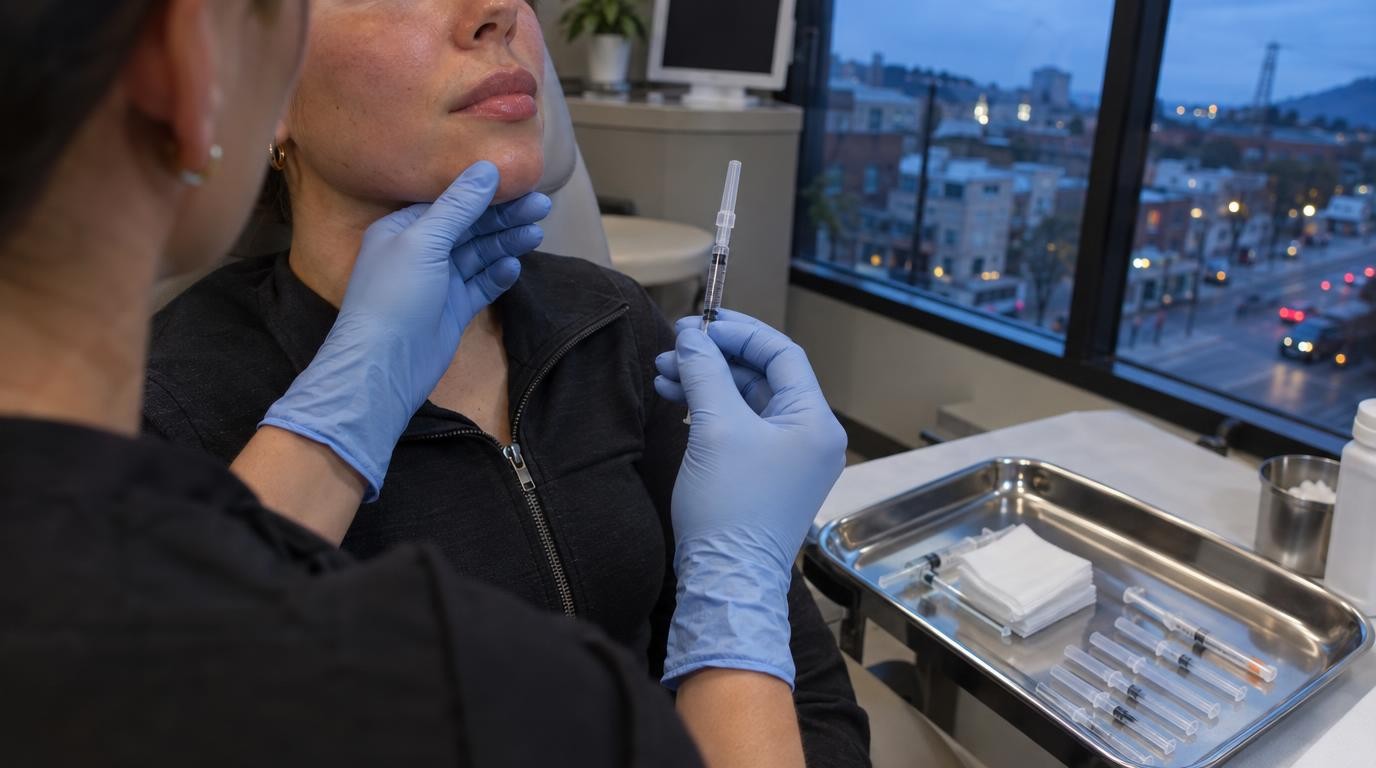
Cheek and chin filler treatment generally follows three steps:
- Review your facial proportions and the change you want.
- Plan and administer hyaluronic acid filler injections based on the areas being treated and your anatomy.
- Review the resulting contour and your aftercare instructions.
How Does a Clinician Plan Where to Place Chin Filler?
Planning starts with the chin’s existing shape, its relationship to the cheeks and jawline, and the amount of visible projection sought. A 2022 retrospective chin augmentation series in Dermatologic Surgery describes hyaluronic acid placement guided by chin anatomy using a needle and cannula.
What Should You Discuss at Your Consultation?
Bring up what bothers you in profile and from the front, whether you want a subtle preview or a more pronounced change, and any previous facial treatment. Discuss your medical history, allergies, current medicines and what a satisfactory result would look like to you. The assessment should also distinguish chin projection from cheek volume, jawline contour and under-chin fullness. Ask which specific filler we propose for your chin and whether that product is FDA-approved for chin augmentation. Using a filler outside its FDA-approved indication is called off-label use; the American Society of Plastic Surgeons’ chin surgery guidance discusses that possibility. We can review the proposed product’s risks and alternatives with you. For more on planning goals, see our facial filler consultation guide.
What Is Recovery Like After Chin Filler?
Chin filler typically involves minimal downtime, but swelling or bruising may persist for several days. Your recovery and the time to a settled contour vary, so the appearance immediately after injection may change as swelling subsides.
Which Short-Term Changes Are Common After Injections?
The injection sites may feel tender. Follow your treatment-specific aftercare instructions, and ask your injector when to reassess any unevenness after the initial swelling has settled.
When Should You Contact Your Injector After Treatment?
Contact your injector immediately if pain becomes severe or worsens, or if skin turns unusually pale, dusky or mottled; these can be signs of reduced blood flow that needs urgent treatment. Seek emergency medical care immediately for any vision changes after filler. Do not wait for routine swelling to resolve.
What Results Can You Expect From Chin Filler?
Chin filler can produce a visible change in projection and contour, but the degree of improvement depends on baseline anatomy and treatment goals.
What Did the 326-Patient Chin Filler Study Find?
The 2022 retrospective study in Dermatologic Surgery reported the following chin-filler outcomes:
| Measure | Finding in the 2022 Dermatologic Surgery series |
|---|---|
| Patients reviewed | 326 |
| Median hyaluronic acid volume injected | 1.85 mL |
| Immediate shape and contour | Improvement reported for all 326 patients |
| Patient satisfaction | Reported by all patients |
The 2022 Dermatologic Surgery series was a retrospective review, not a personalized dosing guide. The amount suitable for one chin cannot be determined from its median, and satisfaction reported by one study group should not be read as a promise of individual chin filler results.
How Long Do Chin Filler Results Last?
Chin filler results are temporary: the American Academy of Facial Plastic and Reconstructive Surgery says most fillers last six to 18 months, with some types lasting longer. In the 2022 Dermatologic Surgery series, most improvement remained at six months. Our cheek filler can provide fullness for about a year, but that cheek-specific estimate does not predict the duration of chin filler.
Will Chin Filler Still Be Visible After a Year?
It may be, though the change may be less pronounced than it was soon after treatment. The 2022 Dermatologic Surgery series reported partial chin improvement still visible at 12 months; that finding does not predict how long an individual result will remain noticeable.
How Does Chin Filler Compare With Other Facial Contouring Options?
Facial contouring options differ by the concern they address and the kind of change they make:
| Option | Primary concern | Key difference |
|---|---|---|
| Chin filler | Limited chin projection | Adds temporary volume without moving bone |
| Jawline filler | An undefined jaw border | Adds temporary contour along the jaw |
| Cheek filler or fat injection | Flat or hollow cheeks | Adds cheek fullness with filler or the patient’s own fat |
| Chin implant or sliding genioplasty | A structural chin-projection goal | Places an implant at the bone or moves part of the chin bone |
| Under-chin fat treatment | Fullness caused by fat | Addresses fat rather than adding chin projection |
When Is Jawline Filler Different From Chin Filler?
Cleveland Clinic’s overview of jawline filler says repeat injections are needed every six to 18 months. The placement and amount needed to define a jaw border may differ from a plan focused on chin projection, so we would assess both areas before recommending injection sites.
How Are Cheek Fat Injections Different From Fillers?
Unlike a filler injection, cheek fat transfer requires harvesting fat from another part of your body before placing it in the cheeks. Ask about recovery at both the donor site and the cheeks when comparing these options; we can discuss which approach fits the change you want.
What If Under-Chin Fullness Is Caused by Fat?
Johns Hopkins Medicine’s discussion of double-chin treatment describes liposuction to remove fat beneath the chin and deoxycholic acid injections to break it down. Deoxycholic acid, sold as Kybella, is a different injection from filler: it treats under-chin fat rather than adding chin projection. The American Board of Cosmetic Surgery says most cosmetic surgeons recommend four to six Kybella treatments spaced one month apart; Johns Hopkins Medicine notes that neck swelling can last about 10 days after each session. These are general expectations, not a treatment plan for you. For more on these different goals, see our chin filler and under-chin fat treatment guide and an educational overview of weak-chin filler results and alternatives.
What Are the Risks of Chin Filler, and Who Should Avoid It?
Chin filler commonly causes short-term local effects such as swelling, pain or bruising, and unevenness can occur. Rare but serious injection complications include blockage of a blood vessel, which can cause skin injury or vision loss.
What Side Effects Were Reported in the Chin Filler Study?
The 2022 Dermatologic Surgery retrospective series recorded the following effects. Its figures reflect that study’s patients and technique, not the expected rate for every injector or patient.
| Effect | Finding in the 2022 Dermatologic Surgery series |
|---|---|
| Swelling and pain | 284 of 326 patients (87.1%) |
| Local bruising | 31 of 326 patients (9.5%) |
| Asymmetry | Eight of 326 patients (2.5%) |
The 2022 Dermatologic Surgery series reported no infections, embolisms, tissue death, nodules or protruding “witch’s chin” appearance. No events observed in one retrospective group does not rule out uncommon complications, including vascular occlusion.
When Should Filler Be Deferred or Discussed With a Clinician?
Do not proceed with an active infection in or near the planned treatment area. Tell your own clinician about relevant allergies, pregnancy or breastfeeding, and any medicines or supplements that may affect bleeding; these circumstances call for an individualized decision rather than a blanket assumption about suitability. Do not stop a prescribed medicine on your own in preparation for an aesthetic treatment.
Frequently Asked Questions
How long does jowl filler last?
There is no single duration for filler placed around jowls. An article on the American Society of Plastic Surgeons website says thinner fillers used for lines and wrinkles closer to the skin may last 6-12 months. That is not a jowl-specific estimate; the product and placement affect how long results remain visible.
Can chin filler be dissolved if I do not like the result?
Hyaluronic acid chin filler is reversible, unlike a chin implant. Cleveland Clinic identifies hyaluronic acid fillers as reversible, but whether a particular result needs correction or reversal depends on the product and your situation. Ask your injector about your options rather than trying to change the result yourself.
Can chin filler make my nose look smaller?
Chin filler cannot change the size of your nose, but added chin projection may make it look less prominent in profile. An article on the American Society of Plastic Surgeons website notes that a recessed chin can make the nose appear larger by comparison. Whether filler improves that balance depends on your facial proportions.
Can a weak chin make a double chin look worse?
Yes. Limited chin projection can make fullness beneath the chin more noticeable, even though it does not create or remove under-chin fat. The American Academy of Facial Plastic and Reconstructive Surgery notes that increasing projection may reduce the visual impact of a double chin caused by an under-projected chin. The appearance may also involve fat or loose skin, which adding chin volume does not remove.
Can chin filler make an uneven chin look more symmetrical?
Chin filler may improve visible asymmetry when adding volume can balance the chin’s contour, but it cannot reposition uneven bone. An article on the American Society of Plastic Surgeons website lists asymmetrical features among concerns fillers can address. Whether added volume would help depends on what is causing the unevenness.
Is fat grafting an alternative to filler for a weak chin?
Yes, chin fat grafting is another way to add volume, but it is a different procedure from filler injections. Cleveland Clinic explains that a surgeon removes fat from another body area with liposuction and injects it into the chin.
How Can You Decide Whether Chin Filler Is Right for You?
Decide whether a temporary improvement in chin projection matches the change you want, then consider cheek balance, recovery and injection risks. At your consultation, show us the profile or angles that concern you and describe any change in how your teeth meet so we can discuss appropriate next steps.
- Projection: Do you want a subtle contour change, or a more substantial structural change?
- Facial balance: Are hollow cheeks, the jawline or under-chin fullness part of what you see?
- Temporary results: Are you comfortable with an effect that can fade?
- Recovery and risks: Can you account for possible local effects and recognize symptoms needing prompt assessment?
- Further evaluation: Would a concern about jaw position or your bite be better assessed beyond filler?
If you are considering dermal fillers for a weak chin, contact VIP Aesthetics and Wellness in Portland, Oregon, to discuss a personalized cheek and chin augmentation consultation. We can help you clarify the change you want and whether a filler-based plan fits that goal.
This information is general and is not medical advice. Talk to a licensed clinician about your own situation before making a treatment decision.






