Last updated: November 13, 2026
Dysport versus Xeomin comes down to formulation, individual response and a treatment plan for your frown lines – not a reliable shortcut for converting units between brands. Both temporarily soften lines caused by frowning, but Xeomin lacks the accessory proteins found with Dysport; that difference has not been shown to make Xeomin work better or prevent resistance. At VIP MEDISPA in Portland, Oregon, we offer Dysport treatment for frown lines and Xeomin.
What Is the Difference Between Dysport and Xeomin?
Dysport and Xeomin are botulinum toxin type A injections used to temporarily improve frown lines, but their formulations differ. Dysport contains accessory proteins alongside its active neurotoxin; Xeomin does not. The products also have different manufacturing processes and potency units, so a difference in formulation does not establish that one delivers better results for a particular patient.

How do their formulations differ?
Dysport contains abobotulinumtoxinA, while Xeomin contains incobotulinumtoxinA. A 2018 analysis in Toxins found similar activity of the active neurotoxin’s light chain in the products it tested, while emphasizing that their formulations and potency units are not interchangeable. The amount measured in a vial is not, by itself, a prediction of how a patient’s frown lines will respond.
Does Xeomin’s lack of accessory proteins prevent treatment resistance?
No prevention claim has been established. Accessory-protein-free Xeomin may interest someone concerned about response after repeated treatments, but formulation alone cannot tell whether that person will develop antibodies or lose a clinical response. In an FDA letter addressing Xeomin promotional claims, the agency said it was not aware of head-to-head evidence supporting a unique added benefit for Xeomin in treating moderate to severe frown lines. If results seem to fade, treatment history and technique deserve review rather than an automatic brand switch.
How Do Dysport and Xeomin Treat Frown Lines?
Dysport and Xeomin temporarily reduce the nerve signaling that makes targeted muscles contract. Repeated contractions between the eyebrows contribute to dynamic frown lines, so relaxing those muscles can soften the lines’ appearance. Muscles outside the treated area can continue to move.
Can Dysport and Xeomin Units Be Compared Directly?
No. Dysport and Xeomin use product-specific potency units, so neither a unit-for-unit swap nor a fixed cross-brand conversion is established.
For a side-by-side comparison, the FDA Dysport prescribing information gives the Dysport frown-line regimen, and the American Society for Dermatologic Surgery says neuromodulator effects typically last about three months.
| Product | Accessory proteins | Frown-line dosing | Typical duration |
|---|---|---|---|
| Dysport | Present | 50 Dysport units in five intramuscular injections of 10 units each | About three months |
| Xeomin | Absent | 20 Xeomin units in five intramuscular injections of 4 units each; not calculated from the Dysport dose | About three months |
What does 50 units of Dysport equal to in Botox?
A Cleveland Clinic comparison of Dysport and Botox describes an informal rule of about three Dysport units to one Botox unit. By that shorthand, 50 Dysport units would be roughly 17 Botox units—but that is not an interchangeable or recommended dose. Dysport’s FDA labeling says its units cannot be converted into another product’s units. Your injector must select a dose based on your muscles and treatment goals. Our Botox or Dysport comparison offers more context for that separate choice.
How Soon Do Dysport and Xeomin Work, and How Long Do Results Last?
Cleveland Clinic says Dysport usually starts working within a few days; its discussion of Xeomin describes results appearing within three to five days. Those descriptions are not head-to-head evidence that either brand consistently works faster. Allow about two weeks before judging the full effect of either treatment rather than treating the first visible change as the final result; timing varies by person.
The FDA Dysport label says its clinical effect may last up to four months and that retreatment should occur no more frequently than every three months. Cleveland Clinic notes that Xeomin results may last up to six months for some people, although about three months is typical for these treatments. Neither upper-end duration is a promise, and the possibility of a longer Xeomin result does not establish that it lasts longer than Dysport for frown lines. If you are tracking your response, note when movement begins to soften, when you are satisfied with the effect and when the original movement returns. Our Dysport results timeline offers more detail.
What Happens During and After Dysport Injections?
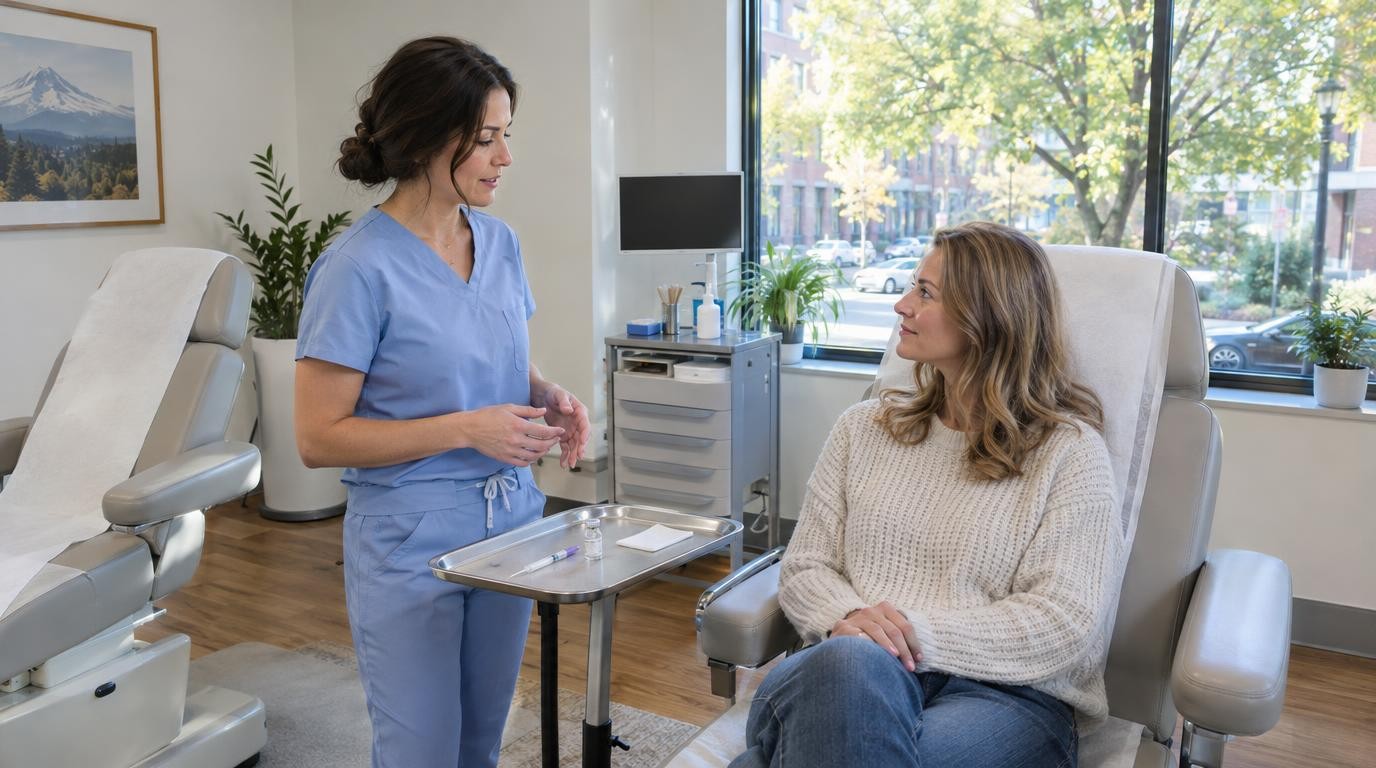
At VIP MEDISPA, we assess whether Dysport is appropriate before administering it. For frown lines, we use five injection points between and above the eyebrows.
- Consultation: Discuss prior injectable experiences, medications and health concerns so the treatment plan reflects your circumstances.
- Assessment and injections: The injection pattern targets the muscles contributing to frown lines while leaving other muscles untreated.
- Aftercare and follow-up: There is usually little or no downtime, and you can generally return to ordinary activities the same day if you feel well. Injection-site soreness or mild bruising may occur, and a slight headache can last several hours. Follow the instructions we provide at your visit and allow the effect to develop before judging your result.

Your recovery and final result can vary; we cannot guarantee a particular outcome.
Who Might Choose Dysport or Ask About Xeomin?
The expression you want after treatment matters: some patients prefer subtle softening, while others want a stronger reduction in frowning movement. Tell us what you hope to change and what movement you want to keep so we can discuss which muscles to treat and where to place injections.
Why do people prefer Botox over Dysport?
Some people favor Botox because they liked a previous result. Dysport is also often described as spreading more widely than Botox, while Botox’s more limited spread may be useful for targeted areas, such as around the eyes. Spread is a treatment-planning consideration, not a guarantee that Botox will work better; injection technique and your goals matter, too.
Why would someone choose Xeomin over Botox?
Xeomin’s lack of accessory proteins may appeal to someone who wants to discuss repeated exposure to those proteins. That is a formulation preference, not proof of lower clinical resistance or better frown-line results.
What Are the Risks of Dysport and Xeomin, and Who Should Avoid Them?
Dysport and Xeomin can cause local reactions or unintended weakening of nearby muscles. Both also carry a warning that toxin effects can spread beyond the injection area and cause serious difficulty speaking, swallowing or breathing. These symptoms can appear hours to weeks after an injection; seek urgent medical help if they occur.
What are the downsides of Dysport?
For frown-line treatment, Dysport’s FDA labeling lists headache, eyelid drooping, injection-site pain or reactions, eyelid swelling, nausea, and cold-like nasal or throat symptoms among commonly reported effects. Xeomin’s FDA safety information reports headache and eyelid drooping after frown-line injections; injection-site bruising can also occur. Temporary eyebrow drooping or asymmetry is another possible Dysport effect noted in Cleveland Clinic’s neuromodulator information. These effects are distinct from the serious spread-of-toxin symptoms described above.
Both products are contraindicated if you have a history of hypersensitivity to any botulinum toxin product or an ingredient in the product being considered, or an infection at the proposed injection site. Dysport’s FDA labeling also contraindicates it for people with a known cow’s milk protein allergy; that restriction is specific to Dysport. Xeomin’s different formulation does not establish that it is safe for someone with a suspected toxin allergy. Review neuromuscular conditions, relevant medications, pregnancy or breastfeeding, and your individual risks with us before treatment.
Frequently Asked Questions
Can Dysport remove frown lines that show when my face is relaxed?
Not necessarily. Dysport relaxes muscles that create movement-related frown lines, so it is best suited to lines that deepen when you frown. A crease visible while your face is relaxed may not disappear with muscle relaxation alone.
Am I too old for Dysport frown-line treatment?
Dysport is FDA-approved to temporarily improve moderate to severe frown lines in adults younger than 65. Frown-line treatment at age 65 or older is off-label; age alone does not determine whether it is appropriate.
Can Dysport treat my forehead lines or crow’s feet?
Dysport’s FDA cosmetic approval covers frown lines between the eyebrows. Using Dysport for horizontal forehead lines or crow’s feet is off-label. Tell us which areas concern you so we can discuss treatment options and their product-specific approvals.
Can I drive after Dysport injections?
If Dysport causes muscle weakness, blurred vision or drooping eyelids, do not drive or operate machinery. These effects may develop after you leave the clinic, so do not resume those activities while they make them unsafe.
What causes a droopy eyelid after Dysport, and can it be prevented?
An eyelid can droop if treatment weakens a muscle near the intended frown-line muscles. This effect is generally temporary. Careful injection technique can reduce, but not eliminate, the risk.
Can I switch from Xeomin to Dysport if I don’t like my results?
Yes. Switching to Dysport for a later frown-line treatment is possible, but your response to Xeomin and the time since your last injection matter. The products’ units cannot be converted directly, and switching brands does not guarantee a better result.
How Can Portland Patients Decide Whether Dysport Fits Their Goals?
Dysport may fit if you want to soften moderate to severe frown lines that deepen when you frown and you are comfortable maintaining a temporary result. Before recommending Dysport or Xeomin, we also consider your response to previous injections, relevant allergies and health conditions, and whether repeat treatment fits your goals.
- Which frown-line movements or changes would you most like to address?
- How did you respond to any previous injectable treatment?
- Are there health conditions, medications or allergies to review?
- Are you comfortable with an effect that wears off and may require repeat treatment?
- What would you like to understand about accessory proteins and alternatives?
For a consultation about your frown lines and whether Dysport or Xeomin fits your goals, contact VIP MEDISPA in Portland, Oregon.
This information is general and is not medical advice. Talk to a licensed clinician about your own situation before making a treatment decision.