

Last updated: November 14, 2026
Botox around eyes can temporarily soften crow’s feet at the outer corners, but it will not remove under-eye bags or reliably correct dark circles. At Vip MediSpa in Portland, Oregon, our Botox injection service begins with identifying the concern you want to treat, because outer-corner lines and under-eye changes call for different assessments.
Does Botox around eyes help with wrinkles?
Yes. Botox can soften movement-related wrinkles at the outer eye corners, but fine lines caused by sun damage and deep creases caused by lost volume may improve little or not at all.
Is Botox for crow’s feet FDA-approved?
Yes. The FDA prescribing information for BOTOX Cosmetic lists moderate-to-severe lateral canthal lines associated with orbicularis oculi activity as an approved cosmetic indication.
Is Botox under the eyes FDA-approved?
No. The crow’s-feet indication does not extend to injections along the lower eyelid or into the tear-trough area.
The location of the concern changes what Botox can reasonably do:
| Concern | BOTOX Cosmetic status | Realistic expectation |
|---|---|---|
| Movement-related lines at the outer eye corners | FDA-approved crow’s-feet indication | Temporary softening of lines caused by muscle contraction |
| Lines or hollows beneath the lower eyelid | Off-label injection area | Benefit depends on the cause; hollows are not filled by Botox |
How does Botox soften crow’s feet?
Botox softens crow’s feet by temporarily reducing contraction of the orbicularis oculi muscle around the outer eye. A literature review in Clinical, Cosmetic and Investigational Dermatology explains that Botox inhibits the release of acetylcholine, a chemical signal involved in muscle movement. As the muscle contracts less forcefully, movement-related lines may look less pronounced; Botox does not immediately fill skin or produce collagen.
Which lines respond best when you smile or squint?
Lines that deepen when you smile or squint are dynamic wrinkles and are the clearest match for crow’s-feet treatment. Lines visible even when the face is relaxed may soften, but muscle relaxation alone may not fully erase them. For a broader look at causes and treatment approaches, see our guide to fine-line reduction.
For movement-related crow’s feet, another botulinum toxin product might be considered, but products are not interchangeable, and approval for one treatment area does not mean a product is approved for crow’s feet. Ask whether a proposed use is off-label. Skin resurfacing may be more relevant for fine lines from sun damage or uneven texture, while volume-restoring treatments may help selected hollows or creases caused by volume loss. Our Botox and Dysport comparison offers further reading.
Who is a good candidate for Botox around the eyes?
A potential candidate is an adult seeking temporary improvement in crow’s feet that become more noticeable with facial movement. A useful assessment considers the lines at rest and during expression, eyelid function, eye symptoms, medical history, and the result the person hopes to see. Treatment suitability depends on those findings, not age alone.
When might Botox be the wrong treatment for an eye-area concern?
Botox may be a poor match when the main concern is puffiness, a hollow tear trough, dark pigmentation, or loose skin rather than outer-corner lines caused by movement. In clinical practice, identifying what creates the visible change matters more than treating every eye-area concern as a wrinkle. Existing dry eye or eyelid-function concerns also deserve particular attention before injections near the eyes.
Can Botox treat under-eye bags or dark circles?
Generally, no. Botox does not remove protruding fat, replace lost volume, or correct pigment that makes the under-eye area look dark.
What should you ask about instead of under-eye Botox?
Ask what is causing the change: a fat pad, a hollow that casts a shadow, pigmentation, or skin texture. An article on the American Society of Plastic Surgeons’ website distinguishes improvement in surrounding wrinkles from removal of the bags themselves. An article on the American Society of Plastic Surgeons’ website describes filler for selected hollows, laser resurfacing or microneedling for crepey skin, and lower eyelid surgery for true bags caused by protruding fat. Our overview of under-eye treatment approaches explains why those options address different concerns; no single option suits everyone.
What happens at a Botox appointment for crow’s feet?
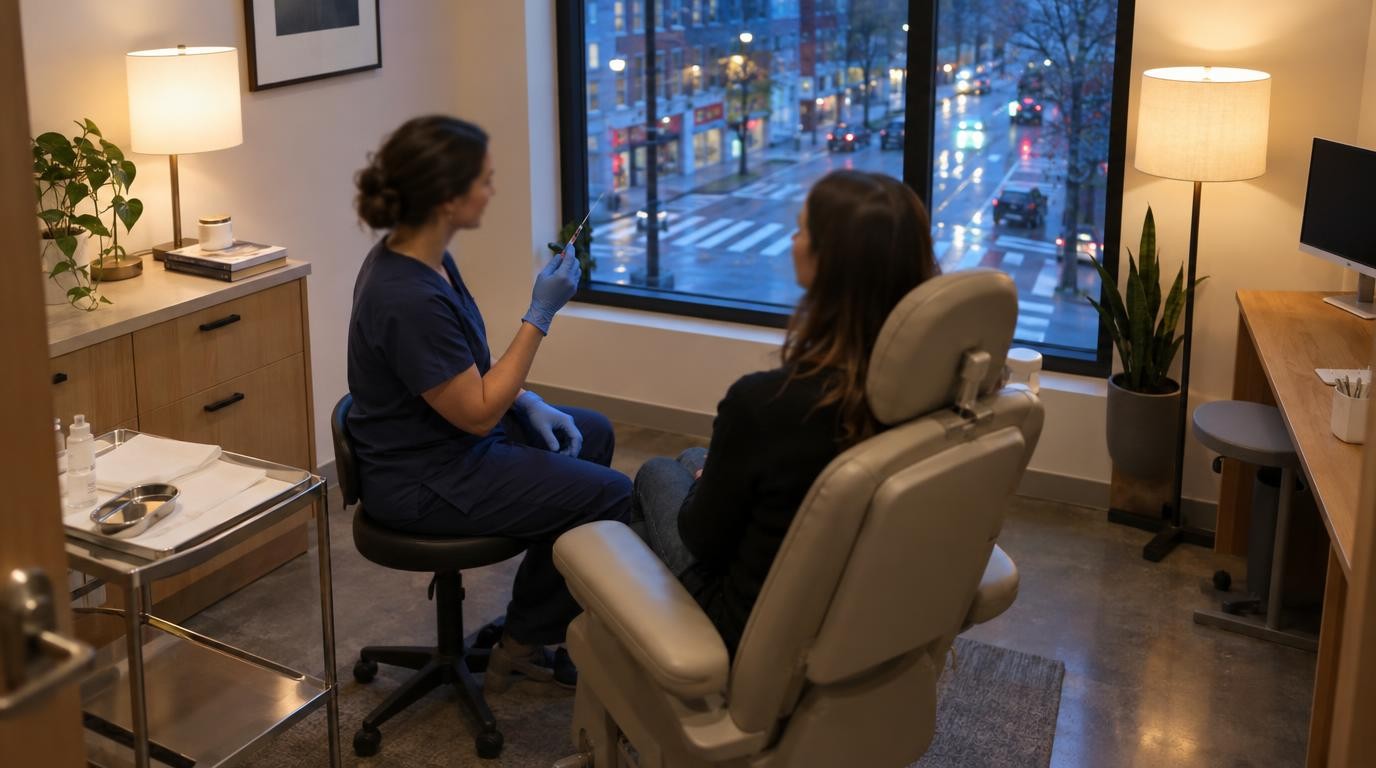
A crow’s-feet appointment starts by checking that the target is movement-related lines at the outer eye corners. After reviewing suitability and the proposed placement, the injector administers small injections into selected muscles. At Vip MediSpa, the treatment appointment takes approximately 15 to 20 minutes, and we use topical numbing cream to reduce discomfort.
What should you tell your injector before treatment?
Share your medications, previous botulinum toxin treatments, allergies, medical conditions, and any dry eye, eyelid weakness, or vision symptoms. Those details help the injector assess whether treatment and placement are appropriate. At Vip MediSpa, your doctor conducts an allergy test a month before the appointment; a negative result cannot rule out every adverse reaction.
What is recovery like after eye-area injections?
Temporary tenderness, bruising, or swelling can occur. At Vip MediSpa, we advise that sensitivity in treated areas may last up to 24 hours, while bruising or swelling may last 3 to 10 days for some patients. An immediate change caused by swelling should not be mistaken for the intended Botox result, which develops as muscle activity decreases.
When will Botox around the eyes work, and how long will it last?
Botox results around the eyes are not immediate. At Vip MediSpa, changes generally become noticeable within days and can last several months, although individual results vary.
Are Botox results immediate?
No. The literature review in Clinical, Cosmetic and Investigational Dermatology reports that the muscle effect can develop from 24 hours to two weeks after injection and last three to six months. Those are review findings, not a guarantee of an individual’s crow’s-feet result.
When might a follow-up be appropriate?
At Vip MediSpa, we may recommend a follow-up treatment 3 to 6 weeks after the first appointment if additional correction is appropriate. Additional injections are not automatic: the decision depends on an assessment of the result, the original goal, and safety.
What are the risks of Botox around the eyes, and who should avoid it?
Botox around the eyes can cause temporary injection-site discomfort, bruising, or swelling, as well as eyelid droop or eye symptoms. In lateral-canthal-line trials, the FDA prescribing information for BOTOX Cosmetic reported eyelid edema (eyelid swelling) in 1% of BOTOX Cosmetic recipients versus 0% of placebo recipients. Those figures do not describe the risk of eyelid droop, systemic effects, or injections beneath the eyes. The FDA lists infection at the proposed injection site and known hypersensitivity to botulinum toxin products or their components as contraindications. People with neuromuscular conditions such as myasthenia gravis or Lambert-Eaton syndrome may have a higher risk of significant muscle weakness or breathing problems.
What is the riskiest place for Botox?
There is no single universally riskiest Botox injection site. Anatomy, placement, dose, and injector skill all affect the risk of unwanted muscle weakening. A BOTOX Cosmetic injection guide hosted by the American Society for Dermatologic Surgery cautions against placement near the levator palpebrae superioris, the muscle that lifts the upper lid, or too close to the central eyebrow because of eyelid-droop risk. The American Society of Plastic Surgeons also warns that lower-lid injections can weaken lid tone and affect how well the lid covers the eye. An American Academy of Ophthalmology discussion of injections around the eyes notes that existing dry eye can worsen. Discuss your eye symptoms and medical history with your licensed clinician before treatment.
Which symptoms need prompt medical attention?
The FDA boxed warning explains that botulinum toxin effects can spread beyond the injection site, with symptoms reported from hours to weeks afterward. Seek urgent medical attention for trouble swallowing or breathing, widespread muscle weakness, new slurred speech or voice changes, or double vision. Report other new vision changes, marked eyelid droop, or difficulty closing the eye promptly as well.
Frequently Asked Questions
Why are Gen Z saying no to Botox?
Gen Z adults do not all feel the same way about Botox; saying the whole generation is rejecting it overstates the case. Some may prefer no injections, while others want a subtler change. Cleveland Clinic’s discussion of lower-dose “Baby Botox” explains why smaller doses may appeal to patients seeking subtle results, but they can still cause side effects, including eyelid droop.
What are the newest procedures for treating bags under the eyes?
There is no single newest procedure for every under-eye bag. The American Society of Plastic Surgeons describes erbium laser resurfacing or microinfusion microneedling with PRP for crepey skin. The American Board of Cosmetic Surgery’s discussion of Juvéderm Volbella XC describes this FDA-approved under-eye filler as an option for camouflaging selected hollows or contour changes, not removing protruding fat. For true bags caused by protruding fat, lower blepharoplasty can remove or reposition fat, sometimes with fat grafting.
Can Botox under the eyes make bags or sagging worse?
Yes, lower-eyelid Botox can potentially make bagging or sagging more noticeable. In an article on the American Society of Plastic Surgeons’ website, Tarick Smaili, MD, notes that some injectors avoid this off-label placement because of risks including lower-lid sagging and difficulty blinking. Crow’s-feet injections at the outer corners are a different placement, so discuss the proposed site before treatment.
Can Botox around the eyes help lift an uneven eyebrow?
Botox may help correct some eyebrow asymmetry by changing how nearby muscles pull, but it is not a guaranteed eyebrow lift. In his article for the American Society of Plastic Surgeons, Tarick Smaili, MD, also notes this potential use and the importance of meticulous placement to avoid a drooping eyelid.
Can Botox treat an eyelid twitch or a misaligned eye?
Botox is used medically for blepharospasm (involuntary eyelid spasms) and strabismus (misaligned eyes), but an occasional eyelid twitch is not necessarily blepharospasm. The American Academy of Ophthalmology describes injections into targeted muscles for these conditions; they differ from cosmetic crow’s-feet injections.
Can I get Botox around my eyes while pregnant or breastfeeding?
Botox is generally not recommended during pregnancy or breastfeeding. Mayo Clinic advises that health care providers generally do not recommend Botox in either situation.
How often would I need Botox to maintain smoother crow’s feet?
Maintaining smoother crow’s feet usually requires repeat injections because Botox’s muscle-relaxing effect wears off. In his article for the American Society of Plastic Surgeons, Tarick Smaili, MD, describes repeating eye-area treatment every four to six months to maintain the look. At Vip MediSpa, we assess your results and treatment goals before recommending another appointment; individual timing can vary.
How can you decide if eye-area Botox is right for you?
Start by identifying whether your concern is crow’s feet at the outer corners or a change beneath the eyes. Botox is an approved option for appropriate movement-related crow’s feet, not a general fix for bags, hollows, or dark circles. A decision should account for realistic improvement, proposed placement, eye health, and when to assess the result.
What should you ask at a consultation in Portland, Oregon?
Bring a description of when the concern is most visible and ask:
- Are these outer-corner movement lines, or is the concern beneath the eye?
- Is the proposed BOTOX Cosmetic placement FDA-approved for crow’s feet or an off-label use?
- What improvement is realistic for my lines at rest and during expression?
- How will my eyelid function, eye symptoms, and medical history affect the risk assessment?
- When should the result be evaluated, and what would justify a follow-up?
If you would like help sorting out an eye-area concern, contact Vip MediSpa in Portland, Oregon, for an individualized Botox consultation. Our team can assess whether crow’s-feet treatment fits your goal and explain when Botox is unlikely to address the change you see.
This information is general and is not medical advice. Talk to a licensed clinician about your own situation before making a treatment decision.






