

Last updated: November 18, 2026
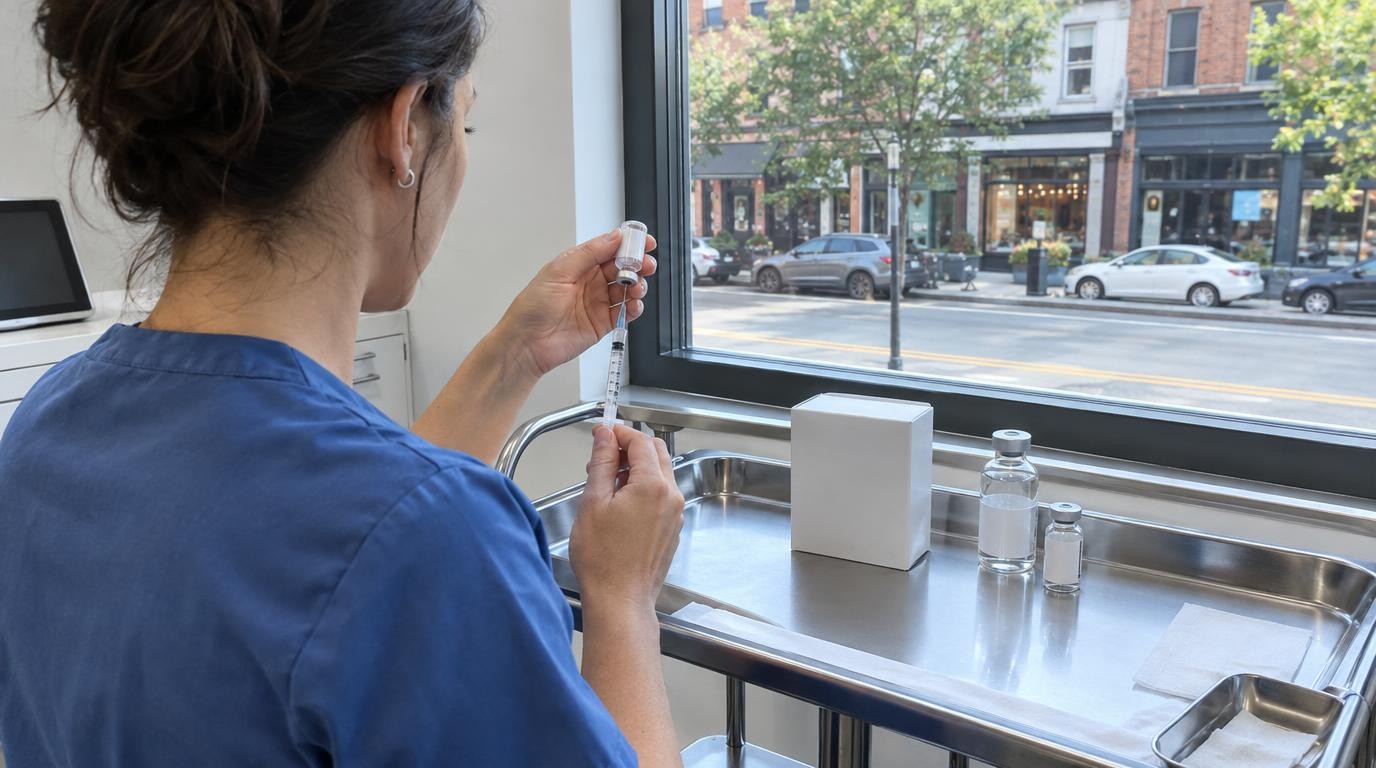
Hyperdilute Radiesse is calcium hydroxylapatite filler mixed with additional fluid so an injector can distribute it more broadly for skin-quality goals rather than use it primarily for immediate lift. It is a technique, not a separate product. At VIP MediSpa in Portland, Oregon, our Radiesse treatment service focuses on standard volumizing filler; patients interested in hyperdilution should confirm whether we currently provide that specific technique.
What Is Hyperdilute Radiesse?
Adding diluent increases the mixture’s total volume without increasing the amount of CaHA in the original Radiesse syringe. “Hyperdilute” does not specify a universal mixing ratio; the proportions must be chosen for the proposed treatment site and skin concern.
How Is It Different From Standard Radiesse Filler?
Standard Radiesse is a cohesive gel used to add fullness and support where volume has been lost. Adding fluid makes the preparation less concentrated and better suited to distribution across an appropriately selected area. The choice is about the treatment goal as well as the product: a person seeking a more defined contour may need a different approach from someone concerned mainly with skin quality.
Is Hyperdilute Radiesse Intended to Add Volume?
Meaningful, immediate projection is not the main goal of hyperdilution. A published case series on hyperdiluted Radiesse describes improvements in skin quality and firmness without volume augmentation. Standard Radiesse, by contrast, produces visible fullness when injected. Patients can explore that distinction further in our guide to Radiesse uses and recovery.
What’s in Radiesse, and How Does Hyperdilution Work?
The FDA’s Radiesse device description identifies synthetic CaHA microspheres suspended in a gel of sterile water, glycerin, and sodium carboxymethylcellulose. Adding sterile fluid changes how the preparation distributes through tissue, while the CaHA remains the material associated with gradual collagen-related changes. The dilution and injection method must match the treatment site, the intended result, the injector’s training, and applicable U.S. labeling.
What Does a 1:2 Radiesse Dilution Mean?
In the FDA labeling for Radiesse, the 1:2 preparation for treating décolleté wrinkles means 1.5 mL of Radiesse mixed with 3.0 mL of sterile saline. The added fluid reduces the concentration of cohesive gel so the material can be distributed across the defined treatment area rather than placed for focused projection.
Terminology matters here: the FDA labeling calls this preparation diluted Radiesse, although patients may encounter the broader term hyperdilute in discussions of skin-quality treatments. The labeled décolleté method specifies subdermal placement with a flexible cannula and indication-specific injector training. It does not establish the same preparation or placement as an approved protocol for every area of loose skin.
How Does Radiesse Stimulate Collagen Over Time?
The gel can provide immediate fullness when standard Radiesse is placed for volume. CaHA also acts as a scaffold associated with the body’s gradual tissue response. The linked case series describes new collagen and elastin formation alongside improvements in firmness and elasticity. Those changes develop over months, and a different distribution of filler does not, by itself, demonstrate a lower risk of injection into a blood vessel.
Who Might Be a Good Candidate for Hyperdilute Radiesse?
An adult concerned primarily with skin texture, firmness, or mild laxity may have reason to ask about diluted Radiesse. Someone seeking immediate cheek fullness or stronger facial definition may be better suited to a volumizing approach. Candidacy depends on an examination, medical history, the proposed injection site, injector expertise, and the labeling that applies to that use.
Which Skin Concerns Might It Address?
Research has explored diluted CaHA for skin-quality concerns, including laxity and wrinkles. The linked case series included treatment of the face, neck, décolleté, and hands. Using diluted Radiesse for skin-quality treatment of the face, neck, or hands is off-label in the United States; the labeled diluted use is for moderate to severe décolleté wrinkles. Significant excess skin is also a different concern from mild laxity; an injectable should not be expected to reproduce a surgical lift.
When Is Standard Radiesse a Better Fit?
If facial volume loss, deeper folds, or a less defined cheek or jawline is the main concern, focused volume replacement may fit the goal better. Our standard Radiesse service is built around immediate fullness and subsequent collagen stimulation. That difference is worth clarifying before choosing a treatment for cheek sagging, smile lines, or jawline definition.
What Happens During a Hyperdilute Radiesse Appointment?
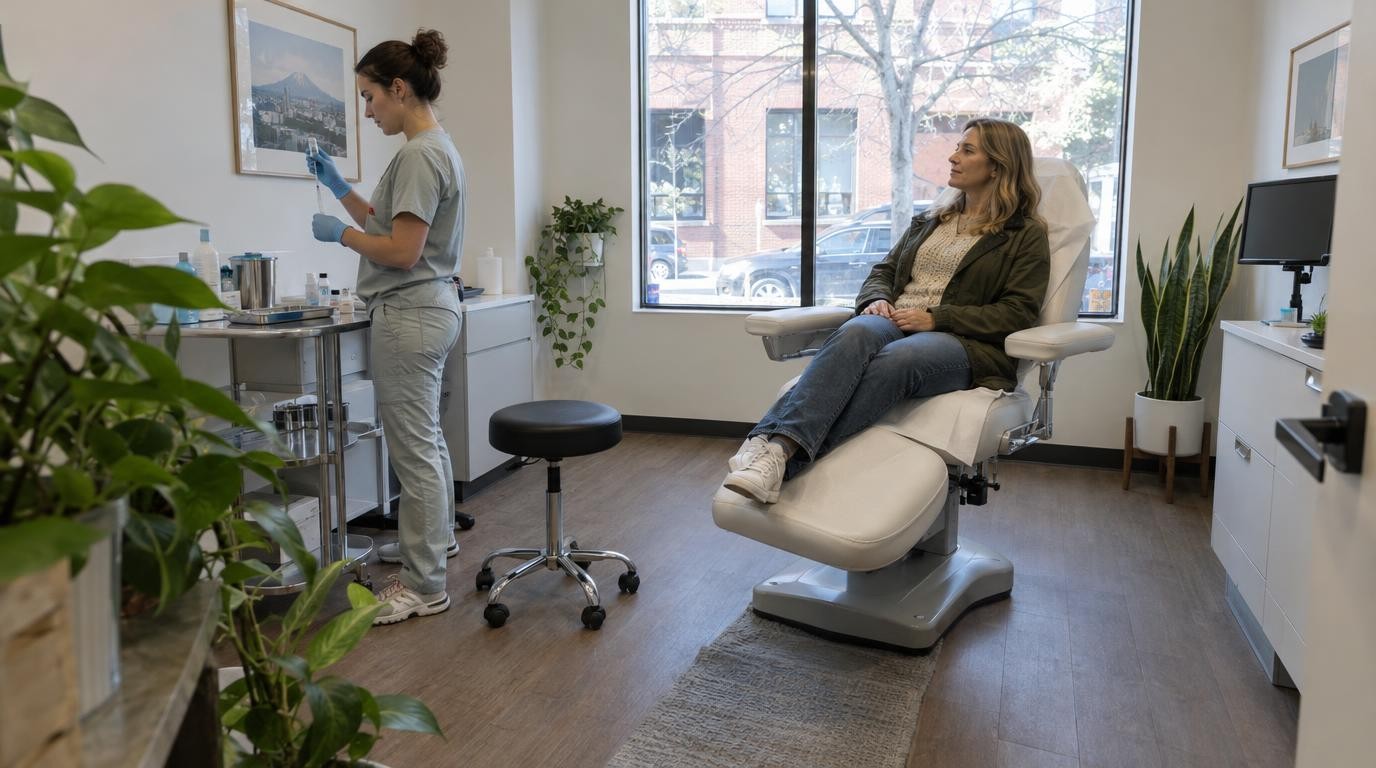
A hyperdilute Radiesse appointment begins with a review of goals and medical history, followed by examination of the proposed treatment area. If the technique is appropriate and available, the injector explains the product, dilution, placement plan, and aftercare before preparing and injecting it. The mixing ratio is a clinical decision, not an at-home preparation instruction.
How Does an Injector Choose a Dilution and Treatment Plan?
The injector first determines whether the desired change is broader skin-quality improvement or concentrated volume. Skin characteristics, anatomy, and the intended site then inform the product and placement plan. Injection depth and technique require a qualified, appropriately trained clinician.
What Should You Ask Before an Injection?
- Is the goal gradual improvement in skin quality or immediate volume?
- Which area would be treated, and what dilution and placement technique would be used?
- Does the proposed use match current U.S. labeling, or would it be off-label?
- What aftercare and follow-up would be appropriate for the treatment plan?
- What training does the injector have for the proposed treatment area and technique?
How Much Downtime Should You Expect After Treatment?
Many patients can return to ordinary, nonstrenuous activities the same day or the next day, although your injector may recommend limits based on the area treated. Redness, tenderness, and swelling often settle within a few days; bruising may remain visible for a week or two. These are general expectations after filler injections, not a guaranteed recovery schedule for hyperdilute Radiesse. Follow the aftercare instructions for your treatment.
Which Short-Term Reactions Are Common?
Injection sites may feel tender or appear red, swollen, or bruised. These reactions are distinct from the gradual skin-quality changes the treatment seeks to produce. Do not judge a collagen-related result by the appearance of freshly injected or swollen skin.
When Should You Contact Your Injector?
Contact the injector if a reaction is worsening, unusually persistent, or concerning to you. Sudden severe pain, a change in skin color, or any vision symptom calls for urgent medical evaluation rather than waiting for a routine follow-up. Those warning signs are discussed further in the risks section below.
When Will Hyperdilute Radiesse Results Become Noticeable?
Skin-quality changes from diluted Radiesse develop gradually over months as tissue responds to CaHA. Hyperdilution is not intended to reproduce the immediate projection of standard volumizing Radiesse. The extent of improvement varies with the starting concern and treatment plan, and results from a décolleté trial should not be assumed for another site.
Why Aren’t Skin-Quality Changes Immediate?
New collagen and elastin formation takes time. In the 50-patient case series cited above, investigators reported improvement in skin thickness, laxity, and wrinkles in 95% of patients aged 30–40, 80% of those aged 40–60, and 70% of those older than 60; they described an average improvement of 81.6% across the study group. Without an untreated comparison group, those findings cannot predict your result or establish how the treatment compares with no treatment. For a more controlled comparison, the FDA’s safety and effectiveness summary for diluted Radiesse reports the following week-24 responder rates on its décolleté-wrinkle scale, measured at rest:
| FDA-reported group | Measure | Finding |
|---|---|---|
| Diluted Radiesse treatment | Response at week 24 | 71.2% of patients |
| Untreated control | Response at week 24 | 6.3% of patients |
The FDA figures measure response on a décolleté-wrinkle scale; they are not a percentage improvement in loose skin generally. They also do not predict an individual’s result. When considering before-and-after photos, look for a comparable treatment area and follow-up point; our before-and-after gallery is a starting point for discussing what a pictured treatment actually involved.
How Do These Results Differ From Standard Radiesse Results?
At VIP MediSpa, standard Radiesse adds volume immediately, while collagen stimulation continues over months. Effects can last at least a year or longer for some individuals receiving standard treatment. That duration should not be transferred to a hyperdilute skin-quality plan without evidence for the specific use. Our Radiesse results timeline explains the distinction between early fullness and later changes.
How Does Hyperdilute Radiesse Compare With Other Injectables?
Hyperdilute CaHA, hyaluronic acid filler, and Sculptra are different materials used for different treatment goals. Diluted CaHA is considered when broader skin quality is the priority; hyaluronic acid filler commonly provides targeted volume; and Sculptra stimulates collagen through a different material. No option is automatically interchangeable with another, particularly when immediate contour or reversibility matters.
The practical differences are easier to see side by side:
| Injectable approach | Primary goal in this comparison | Material distinction |
|---|---|---|
| Hyperdilute Radiesse | Broader skin-quality improvement | Diluted calcium hydroxylapatite filler |
| Hyaluronic acid filler | Targeted fullness or contour | Hyaluronic acid gel |
| Sculptra | Gradual collagen stimulation | Poly-L-lactic acid |
How Is It Different From Hyaluronic Acid Filler?
Hyaluronic acid filler is often chosen when a specific area needs volume or contour. An article on the American Society of Plastic Surgeons’ website notes that, unlike hyaluronic acid fillers, Radiesse has no reversal agent that can dissolve an unwanted result.
How Is It Different From Sculptra?
Sculptra uses poly-L-lactic acid rather than CaHA and is also discussed for gradual collagen-related change. The best fit depends on whether the goal is skin quality, diffuse fullness, or defined projection, as well as the proposed treatment site. Our Radiesse and Sculptra results-timeline comparison and this educational comparison of collagen-stimulating fillers offer more context without treating the products as substitutes for one another.
What Are the Risks, and Who Should Avoid Radiesse Injections?
Radiesse can cause bruising, swelling, redness, and tenderness, as well as less common complications such as lumps, infection, and accidental injection into a blood vessel. Vascular blockage can injure tissue or affect vision. Dilution does not eliminate these risks. Product allergies, certain severe allergy histories, and active problems at the injection site require particular attention.
Investigators reported no significant adverse effects in the 50-patient case series cited above. That small, uncontrolled study cannot establish the frequency of minor reactions or rare vascular complications, or rule out serious harm.
What Side Effects and Rare Complications Should You Know About?
Most expected reactions are local to the injection site, but a lump or nodule, worsening inflammation, or suspected infection needs assessment. Rare vascular complications can cause impaired blood flow and tissue injury; vision symptoms after a filler injection are a medical emergency. Seek urgent medical evaluation for sudden severe pain, unusual skin blanching or darkening, or any change in vision. A different dilution should never be treated as proof that vascular risk has disappeared.
Which Health Factors Should You Discuss Before Treatment?
The FDA Radiesse patient and physician labeling lists a history of anaphylaxis, a history or presence of multiple severe allergies, and known hypersensitivity to product components as contraindications. It directs clinicians to defer injection when active inflammation or infection is present in or near the treatment area until the problem is controlled. The FDA hand-treatment instructions also list bleeding disorders as a contraindication for that indication. Tell your own clinician about allergies, bleeding disorders or other bleeding concerns, relevant medical conditions, and pregnancy or breastfeeding so screening can be individualized; pregnancy and breastfeeding are discussion points, not the labeled contraindications listed here.
Frequently Asked Questions
What filler lasts five years – is it Radiesse?
Bellafill, a PMMA filler, is the product commonly associated with a “five-year filler” claim—not Radiesse. An FDA review of dermal fillers identifies Bellafill as nonabsorbable and Radiesse as absorbable; it does not establish five years of visible improvement for every Bellafill patient. The FDA review reports that standard Radiesse effects lasted one year after the first session in all patients in a clinical study. That finding does not establish how long hyperdilute results last.
Which is better for buttocks, Radiesse or Sculptra?
Neither product has been shown to be better than the other for buttock augmentation. An article on the American Society of Plastic Surgeons’ website discusses Sculptra use for that purpose but provides no direct comparison with Radiesse. Buttock augmentation with either injectable is off-label in the United States.
How many diluted Radiesse treatments are needed for chest wrinkles?
In the FDA-labeled décolleté study, participants received three initial treatments—on Day 1, Week 6, and Week 12—with optional retreatment at Week 36. That study schedule does not set the number of sessions for an individual or for another treatment area.
Can diluted Radiesse be injected into breast tissue?
No. FDA labeling specifies subdermal injection within the defined décolleté treatment area and prohibits injection over or into breast tissue. The labeled method also requires indication-specific injector training.
Do I need an allergy test before Radiesse injections?
According to FDA patient information for hand treatment, routine allergy testing is not required before Radiesse injection. Medical-history screening is still necessary because known hypersensitivity to Radiesse components and certain severe allergy histories are contraindications.
Can I have a laser treatment or chemical peel after Radiesse?
Yes, but laser treatment, chemical peeling, or similar procedures after Radiesse may cause swelling at the implant site, according to FDA patient information for hand treatment. Swelling may also occur if Radiesse is injected before the skin has healed after a laser treatment or chemical peel.
What are alternatives to diluted Radiesse for décolleté wrinkles?
Alternatives listed in the FDA’s décolleté safety and effectiveness summary include other dermal fillers, neurotoxins, chemical peels, intense pulsed light, lasers, and radiofrequency or ultrasound skin tightening. Each has different advantages and disadvantages depending on the concern being treated.
How Can You Decide Whether to Ask About Hyperdilute Radiesse?
Ask about hyperdilute Radiesse if gradual improvement in skin quality matters more to you than immediate added volume. Confirm the proposed site, dilution, expected timeline, risks, and whether the planned use falls within U.S. labeling.
What Should You Confirm at a Portland Consultation?
Bring a clear description of the change you want: firmer-looking skin, more volume, or both. Ask how an injector would assess the area, what result would be realistic, and whether standard Radiesse or another treatment better matches that goal. VIP MediSpa is in Portland, Oregon, near West Linn.
For a personalized discussion, contact VIP MediSpa in Portland at (503) 513-5533 to request a consultation. Dr. Max Grishkevich, MD, is our founder and Medical Director.
This information is general and is not medical advice. Talk to a licensed clinician about your own situation before making a treatment decision.
About the doctor at Vip MediSpa
Dr. Max Grishkevich, MD – Founder and Medical Director of VIP MediSpa; aesthetic physician and member of the American Academy of Cosmetic Surgery.






