


Last updated: October 11, 2026
Thermage before and after changes can be subtle: look for firmer-looking skin and softer fine lines, not the transformation of a surgical lift. Some people notice an early change, while collagen-related changes can develop gradually. At VIP MediSpa in Portland, Oregon, our Thermage skin tightening service is intended for people seeking a nonsurgical option for mild to moderate skin laxity.
What Should Thermage Before and After Photos Actually Show?
Thermage before and after photos may show modest changes, not the effect of a surgical lift. Around the eyes, look for less apparent mild upper-eyelid hooding or softer lines; on the cheeks or jawline, look for a somewhat smoother contour. For the abdomen, arms, or thighs, compare the same patch of loose skin in both images. None of these changes is guaranteed.
How can you compare Thermage photos fairly?
A tilted chin can change the apparent jawline; smiling can change the appearance of eye and mouth wrinkles. Use similar lighting, camera height and distance, posture, and a relaxed expression in each image. Check how long after treatment the second photo was taken before judging a small difference.
Ask when each photo was taken and whether other treatments occurred between images. For more context on appropriate expectations, see our guide to who may benefit from Thermage skin tightening.
How Does Thermage Tighten Skin Without Surgery?
Thermage uses radiofrequency energy to heat tissue beneath the skin while cooling the surface. The heat is intended to affect existing collagen and encourage a longer-term collagen response, which may improve the appearance of laxity and wrinkles. The treatment mechanism does not guarantee that every person will see visible tightening.
Is Thermage a laser treatment?
No. Thermage is radiofrequency skin tightening, not a laser treatment. Our team uses a treatment tip to deliver energy and a cooling spray to protect the skin’s surface. The FDA’s Thermage FLX clearance summary likewise describes radiofrequency delivery through a treatment tip with surface cooling and lists noninvasive wrinkle treatment among the device’s indicated uses.
Laser treatments use light energy rather than Thermage’s radiofrequency energy, and their treatment schedules and recovery can differ. You can read more in our explanation of laser resurfacing and loose skin or an overview of clinical evidence for radiofrequency skin tightening.
How Long Does It Take for Thermage to Take Effect?
Thermage may produce an early feeling or appearance of firmness, but visible changes can also develop gradually as the skin responds. An immediate impression is not the final result. Regularly timed photos offer a more useful comparison than repeatedly checking the mirror, and no follow-up date guarantees a noticeable change.
When should you take Thermage before and after photos?
Take baseline photos before treatment, then repeat them at agreed follow-up visits using the same setup. Keep the photos dated so you and your clinician can compare early and later appearances over several months; no follow-up date is a deadline by which a visible result must appear.
The American Academy of Dermatology notes that results from noninvasive radiofrequency tightening can continue to develop as the body makes collagen, with the best results appearing at about 6 months. That guidance covers a category of treatment rather than predicting any particular Thermage photo.
How long can Thermage results last?
Duration varies with the person, treatment area, skin condition, and ongoing aging. According to the American Academy of Dermatology’s guidance on noninvasive radiofrequency tightening, results can last 2 to 3 years with appropriate skin care. That is general guidance, not a promise that a Thermage result at VIP MediSpa will last for a set period.
What Does the 2026 Thermage Clinical Trial Tell Us About Results?
The 2026 multicenter, randomized, assessor-blind trial in Lasers in Medical Science compared a single Thermage CPT treatment with a different monopolar radiofrequency device; it enrolled 230 people, included 212 in its final analysis, and assessed facial wrinkle improvement at 90 days.
The study reported the following results using the Global Aesthetic Improvement Scale, or GAIS:
| Trial measure | Other radiofrequency device | Thermage CPT |
|---|---|---|
| Participants with a GAIS score of 3 or lower at 90 days | 100% | 98.10% |
Does a 100% improvement figure predict your individual result?
No. The 100% figure means that participants treated with the other device met the study’s GAIS threshold; it does not mean everyone had a dramatic change visible in ordinary before and after photos. The trial reported no significant difference between the two treatment groups, but neither group’s percentage predicts your individual result.
GAIS is an aesthetic improvement rating used for the trial’s facial wrinkle endpoint. It should not be read as a claim that every wrinkle was independently measured, removed, or equally improved. At VIP MediSpa, we use a ThermaCool machine; we would need to confirm its specific model before applying the trial’s Thermage CPT findings to our treatments. Results for facial wrinkles also do not establish results for other treatment areas.
Which Areas and Patients Are Most Likely to Notice a Change?
Thermage is generally a better fit for mild to moderate skin laxity and wrinkles than for substantial sagging. At VIP MediSpa, areas considered for treatment include the jawline, neck, around the eyes, abdomen, and arms. The likely degree of change depends on the skin and the area being treated.
Can Thermage help loose jowls, hooded eyes, or sagging body skin?
Thermage may soften the appearance of mild jawline sag, loose jowls, fine lines around the eyes, or crepey-looking skin in selected body areas. Our team also considers concerns such as upper-eyelid hooding and laxity on the abdomen or arms. Treating skin laxity is different from removing fat, and radiofrequency treatment cannot be expected to correct substantial excess skin or a pronounced double chin.
What Happens During a Thermage Appointment and Recovery?
During a Thermage appointment at VIP MediSpa, a treatment tip delivers radiofrequency energy while cooling helps protect the skin’s surface. You may feel warmth and slight vibration, and our office can offer a simple analgesic for discomfort. Treatment typically takes 30 minutes to 2 hours, depending on the area.
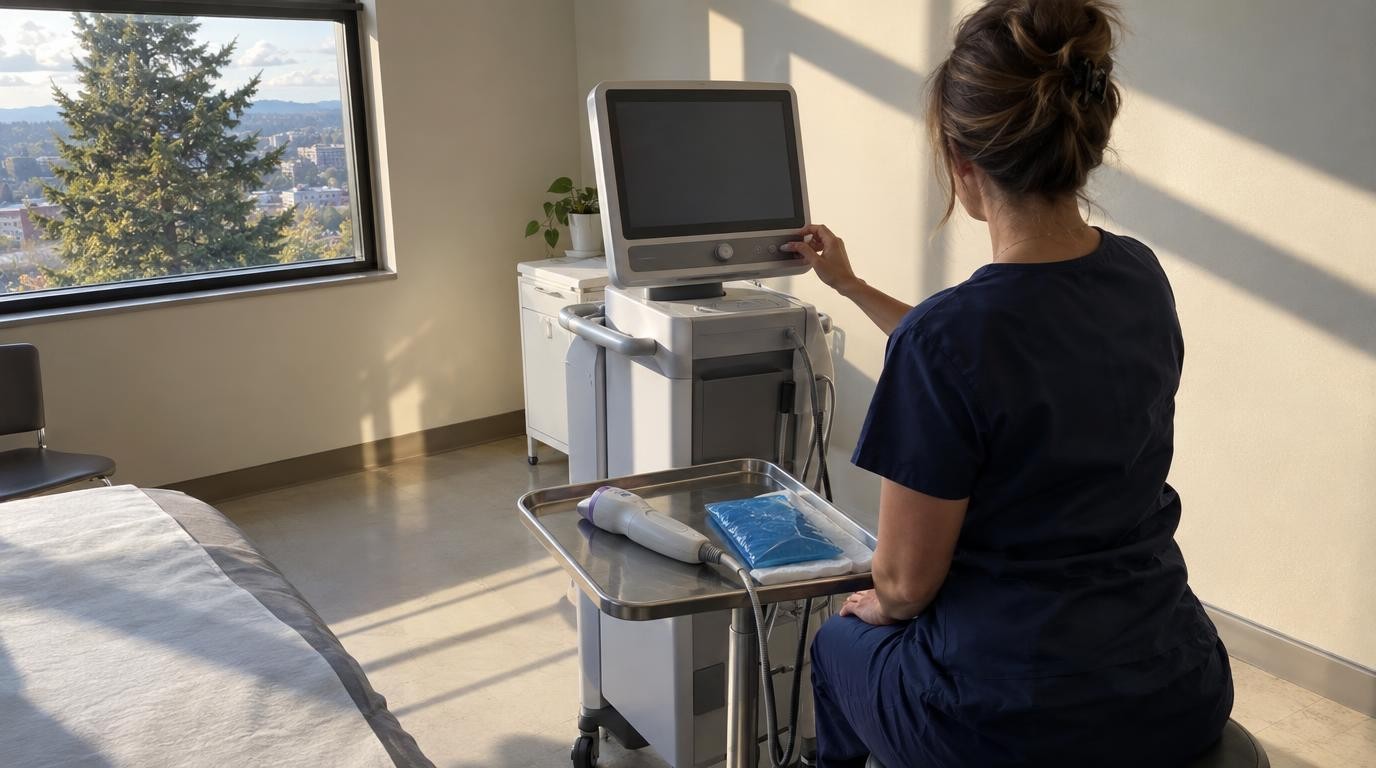
A facial treatment typically takes about 1 hour at our Portland clinic; a body treatment takes around 90 minutes.
Can you return to normal activities after Thermage?
We generally expect no downtime, so many patients can return to their usual activities after the appointment. Individual comfort and skin reactions differ, however. Leave room in your plans for the possibility of temporary redness or swelling rather than assuming your skin will look unchanged immediately afterward.
What Risks or Side Effects Should You Consider Before Thermage?
Thermage can cause redness, bruising, or swelling; those reactions generally resolve within a day or two. Burns and blisters can also occur and may leave scars. Individual device-event reports cannot show how often these complications happen.
The 2026 Lasers in Medical Science trial reported no serious adverse events in its study population; that finding does not rule out complications. Separately, an FDA device-event report describes burns, blistering, and scarring after Thermage FLX treatment.
Who should not have Thermage?
If you have a pacemaker, implanted defibrillator, or another implanted electronic device, do not proceed until your clinician has checked the instructions for the exact ThermaCool model being used; the implant may rule out treatment. Pregnancy or an active infection, open wound, or significant irritation in the proposed treatment area may warrant postponing treatment. Tell your clinician about implants and any previous reaction to an energy-based procedure so they can check the model-specific contraindications and your individual risks.
Contact the treating clinic promptly if discomfort or a skin reaction is worsening rather than settling. Seek urgent medical care for severe pain, significant blistering or burns, or possible signs of infection such as spreading redness, pus, or fever.
Is Thermage Worth Doing Compared With a Surgical Lift?
Thermage and a surgical lift differ in the degree of laxity they can address and the recovery they involve:
| Consideration | Thermage | Surgical lift |
|---|---|---|
| Skin laxity | Generally a better fit for mild to moderate laxity | Can address more pronounced laxity and excess tissue |
| Expected change | Typically modest tightening that can develop gradually | Can reposition or remove tissue; it is not an equivalent result |
| Procedure and recovery | Nonsurgical, with generally no downtime | Involves surgery and a recovery period |
Can Thermage replace surgery for pronounced loose jowls or turkey neck?
Usually not. Radiofrequency treatment cannot be expected to reposition or remove the substantial excess tissue that can cause pronounced loose jowls or a turkey neck. If avoiding surgery is your priority, a smaller, gradual change may still meet your goals.
How do ultrasound and laser tightening compare with Thermage?
Ultherapy uses ultrasound, and laser-tightening treatments use light rather than Thermage’s radiofrequency energy. According to the American Academy of Dermatology, most people see modest lifting or tightening within 2 to 6 months after one ultrasound treatment, though some benefit from additional treatment. The academy notes that some laser-tightening approaches may require 3 to 5 treatments, with gradual results appearing 2 to 6 months after the last treatment. We can discuss the treatment course and recovery that fit your goals; our comparison of Thermage and Ultherapy offers more detail on the ultrasound option.
Frequently Asked Questions
Is Thermage FDA approved?
Thermage FLX is FDA cleared, not FDA approved, for specified uses including noninvasive treatment of wrinkles and wrinkles around the eyes. Its 510(k) clearance means the FDA found it substantially equivalent to a legally marketed device; it is not FDA approval or a guarantee of a particular result.
Do you need more than one Thermage treatment?
Most people have one noninvasive radiofrequency treatment, but some benefit from more than one, according to the American Academy of Dermatology. That category-wide guidance is not a fixed Thermage schedule; whether another session makes sense depends on your response and goals.
Can Thermage be used on the thighs?
Yes. At VIP MediSpa, we offer Thermage for selected areas of loose skin, including the thighs, abdomen, and arms. It aims to firm skin rather than remove substantial excess tissue, and visible changes may be modest.
Can men get Thermage?
Yes. At VIP MediSpa, we offer Thermage to men and women with mild to moderate skin sagging or wrinkles. Suitability depends on your skin, treatment area, goals, and medical history rather than gender.
Can Thermage treat cellulite?
Thermage FLX has an FDA-cleared indication for temporary improvement in the appearance of cellulite when radiofrequency energy and skin vibration are used together. That does not mean cellulite will disappear or establish the same indication for another Thermage device.
Can Thermage correct deep facial folds?
Thermage may soften the appearance of some wrinkles, but deep folds may remain because tightening skin does not necessarily address changes beneath it, such as lost facial volume. We can assess whether a different treatment better matches the concern you want to address.
What if you cannot see a change in your comparison photos?
Bring your dated, consistently taken photos to a follow-up visit. We can examine the treated area and discuss whether more time, another treatment, or a different approach fits your goals; one photo alone is not a reason to repeat a procedure.
How Can Milwaukie Patients Discuss Thermage Results With a Portland Clinician?
If you are coming from Milwaukie, call our Portland clinic at (503) 513-5533 to arrange a consultation. Bring any comparison photos and describe the change you hope to see. Our team will consider the treatment area, degree of laxity, and medical suitability when assessing whether Thermage fits your goal; an individual assessment is more useful than a promised result.

Bring an existing photo if it helps show whether your goal is softer fine lines or a clearer jawline.
If you are considering Thermage, contact VIP MediSpa in Portland, Oregon, for a consultation. Our team can assess your concerns, discuss comparison photos and timing, and help you decide whether nonsurgical tightening fits your goals.
This information is general and is not medical advice. Talk to a licensed clinician about your own situation before making a treatment decision.






